

Blog
ISO 9001 Policy Template: Complete Guide for Businesses

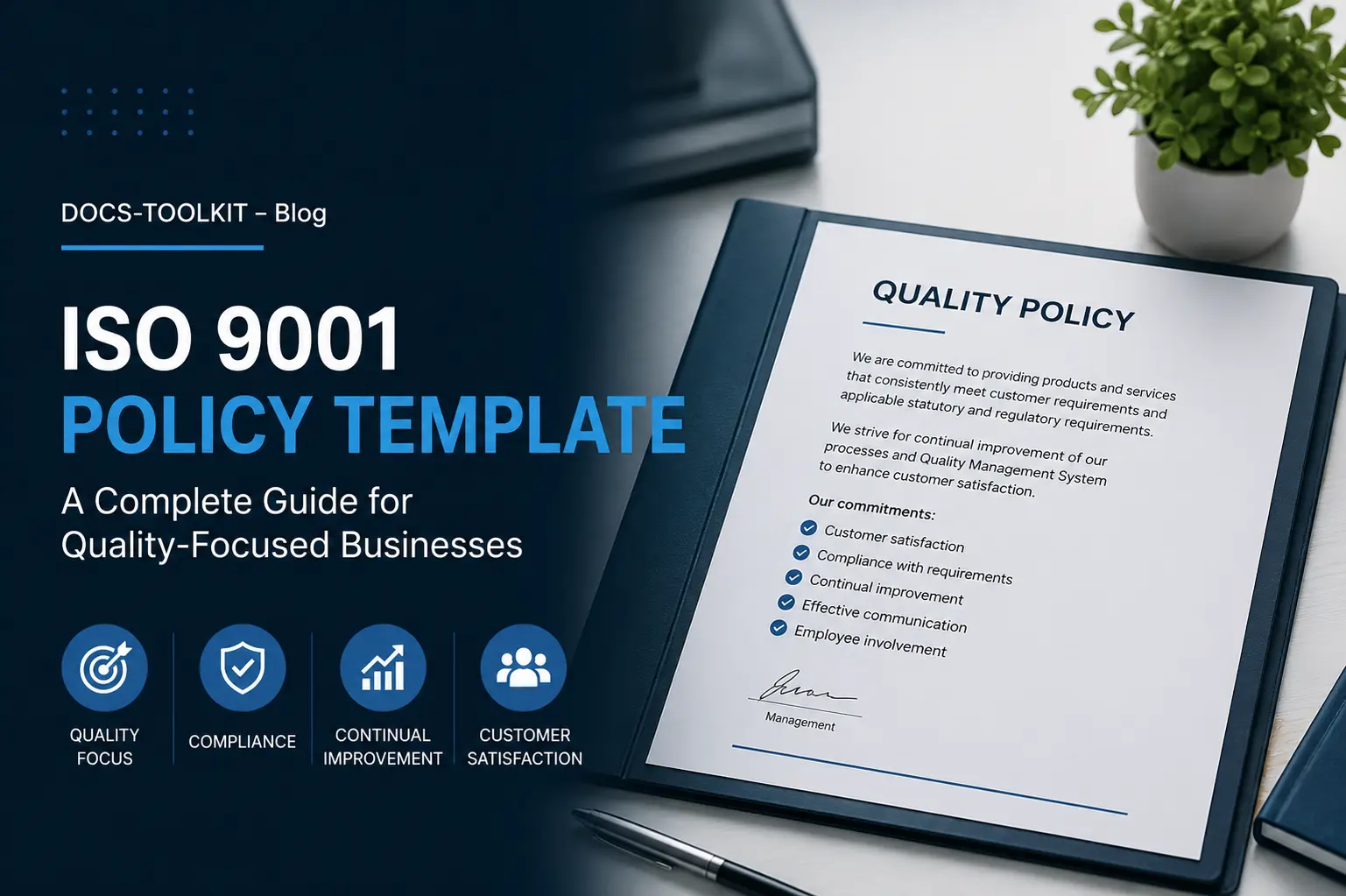
Learn how to create an ISO 9001 policy template, key elements, examples, and best practices to build a compliant quality management system.
ISO 9001 Policy Template
Organizations across industries strive to improve quality, increase customer satisfaction, and create standardized business processes. One of the most recognized frameworks supporting these goals is ISO 9001. Companies seeking certification or improving their quality management system often begin with a fundamental document: the ISO 9001 policy template.
A quality policy is more than a formal statement placed in a manual. It serves as the foundation for organizational quality objectives and demonstrates leadership commitment toward continual improvement.
In this guide, we will explore what an ISO 9001 policy template is, why it matters, essential elements, implementation steps, examples, common mistakes, and best practices.
What Is an ISO 9001 Policy Template?
An ISO 9001 policy template is a structured document used by organizations to define their quality intentions and direction according to ISO 9001 Quality Management System (QMS) requirements.
The template provides a framework that organizations can customize according to:
- Industry
- Company size
- Products and services
- Customer expectations
- Strategic goals
- Regulatory requirements
Rather than creating a quality policy from scratch, businesses use templates to save time and ensure alignment with ISO standards.
A policy template provides consistency and helps organizations avoid overlooking mandatory elements.
The purpose is not to create a generic statement but to produce a policy reflecting the organization’s values and quality commitments.
Understanding ISO 9001 and Quality Policies
ISO 9001 is an internationally recognized standard for Quality Management Systems.
The standard focuses on:
- Customer satisfaction
- Process consistency
- Risk-based thinking
- Continual improvement
- Leadership involvement
- Performance monitoring
Within ISO 9001 requirements, the quality policy acts as a strategic document.
The organization’s leadership is responsible for ensuring the policy:
- Supports organizational purpose
- Aligns with strategic direction
- Provides a framework for objectives
- Includes commitment to improvement
- Meets applicable requirements
Without a clearly defined quality policy, organizations often struggle to maintain consistency throughout their management system.
Why Organizations Need an ISO 9001 Policy Template
Many companies underestimate the importance of quality documentation.
However, a well-developed policy delivers several advantages.
Creates Organizational Direction
Employees need a clear understanding of quality expectations.
A quality policy establishes common goals and priorities.
When departments understand organizational objectives, decision-making becomes more consistent.
Supports Certification Readiness
Certification auditors frequently review the quality policy early in assessments.
Poorly written or incomplete policies may create findings during audits.
Templates help organizations address required clauses.
Improves Communication
Quality policies communicate expectations internally and externally.
Employees understand organizational commitments while customers gain confidence in company standards.
Encourages Continual Improvement
Continual improvement represents a major principle within ISO 9001.
A policy establishes the mindset required for process enhancement and customer-focused operations.
Core Requirements of an ISO 9001 Quality Policy
ISO 9001 contains specific expectations regarding quality policies.
Organizations should ensure their policy includes several critical components.
Commitment to Customer Satisfaction
Organizations exist to provide value.
Customer needs and expectations must remain central.
Quality policies should demonstrate commitment to delivering products and services meeting customer requirements.
Example:
“We are committed to exceeding customer expectations through reliable products and continual process improvement.”
This statement shows customer orientation and commitment.
Commitment to Applicable Requirements
Businesses operate within legal, regulatory, and customer requirements.
Policies should acknowledge these responsibilities.
Example:
“We comply with all applicable legal, regulatory, and customer requirements.”
This reinforces organizational accountability.
Commitment to Continual Improvement
Improvement remains a key requirement.
Policies should clearly indicate ongoing enhancement efforts.
Example:
“We continuously improve our processes and Quality Management System effectiveness.”
Framework for Objectives
Quality policies should support measurable goals.
Objectives may include:
- Reduced defects
- Improved customer satisfaction
- Faster response times
- Reduced waste
- Increased efficiency
Policies should provide strategic direction for these metrics.
Structure of an ISO 9001 Policy Template
Although organizations customize content, most templates follow a similar structure.
Company Information
Include:
- Organization name
- Document title
- Version
- Approval date
- Document owner
Document control supports consistency and revision management.
Policy Statement
This is the main content section.
The policy statement explains commitments and strategic intentions.
Organizations should avoid unnecessary complexity.
Simple language works best.
Scope
Some organizations include applicability information.
Examples:
- Manufacturing operations
- Service delivery
- Internal support functions
Scope clarifies boundaries.
Leadership Commitment
Policies should show active management involvement.
Leadership responsibility is a recurring ISO 9001 theme.
Approval Section
Policies generally include signatures from:
- CEO
- Managing director
- Quality manager
Formal approval demonstrates accountability.
Example ISO 9001 Policy Template
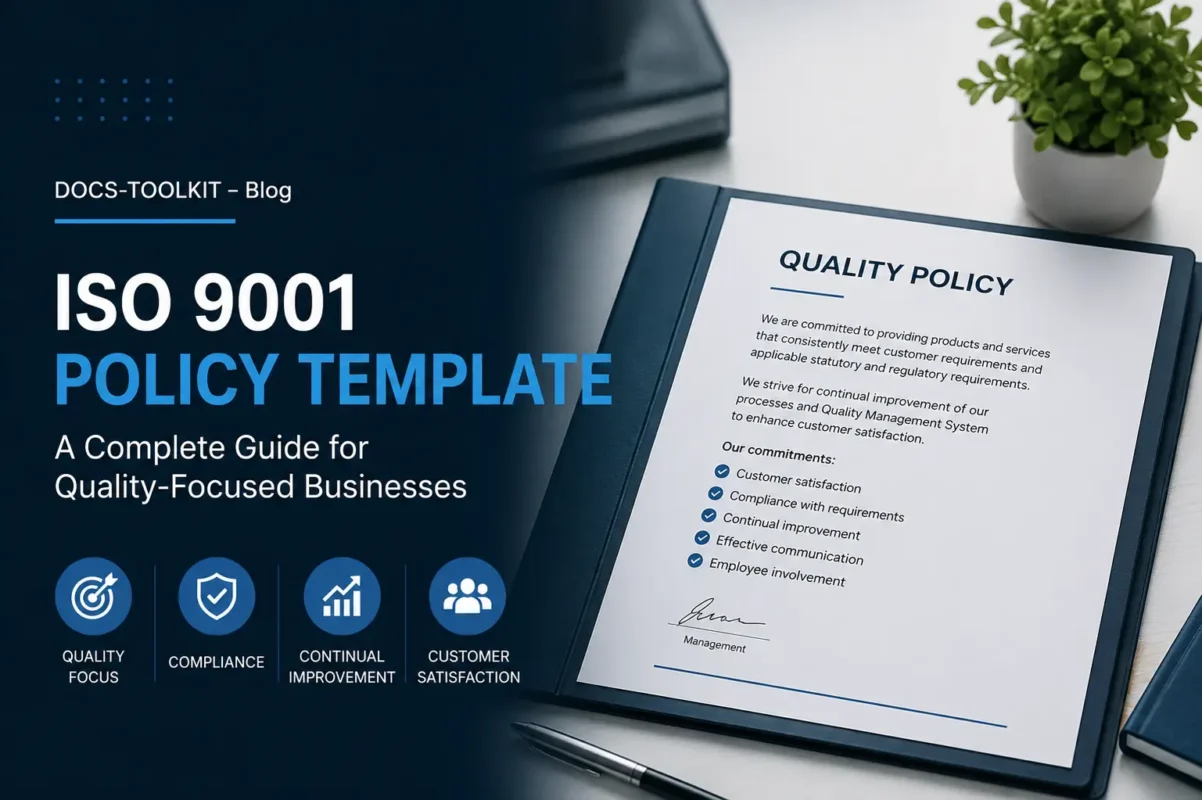
Below is a sample structure organizations can customize.
Quality Policy
[Company Name] is committed to delivering products and services that consistently meet customer expectations and applicable requirements.
We strive to improve customer satisfaction through:
- Effective processes
- Employee involvement
- Risk-based thinking
- Continual improvement initiatives
- Performance monitoring
Management is committed to maintaining and improving our Quality Management System according to ISO 9001 requirements.
Approved by:
Name: __________
Title: __________
Date: __________
This example provides a starting point rather than a final document.
Organizations should customize content according to operations and goals.
Industry-Specific ISO 9001 Policy Template Considerations
Different industries may require additional focus areas.
Manufacturing Companies
Manufacturers often emphasize:
- Defect reduction
- Production efficiency
- Supplier quality
- Equipment reliability
Quality policies may include operational consistency.
Software Organizations
Technology businesses often focus on:
- Product reliability
- Security
- User experience
- Innovation
- Service performance
Policies should reflect digital environments.
Healthcare Organizations
Healthcare organizations may prioritize:
- Patient safety
- Regulatory compliance
- Risk reduction
- Service quality
Sector-specific language improves relevance.
Consulting and Service Companies
Service organizations frequently emphasize:
- Responsiveness
- Customer communication
- Professional expertise
- Service delivery consistency
Templates should align with customer interactions.
Common Mistakes When Creating ISO 9001 Policies
Many organizations unintentionally create weak quality policies.
Understanding common mistakes helps avoid audit findings.
Using Generic Statements
Generic policies lack meaning.
Avoid:
“We provide excellent services and value customers.”
This statement lacks measurable commitment and strategic relevance.
Policies should reflect organizational reality.
Writing Overly Complex Content
Complex language confuses employees.
Simple wording improves understanding.
Employees should easily explain the policy.
Ignoring Strategic Direction
ISO requires alignment with organizational purpose.
Policies disconnected from business goals become ineffective.
Creating Policies Nobody Uses
Some organizations create documents solely for certification.
Effective policies guide actual decision-making.
Leadership should regularly communicate policy content.
How to Implement an ISO 9001 Policy Successfully
Creating a document alone is not enough.
Implementation matters equally.
Step 1: Understand Organizational Goals
Before drafting content:
Evaluate:
- Business objectives
- Customer expectations
- Risks
- Market needs
Policies should support strategic goals.
Step 2: Involve Leadership
Executive involvement improves commitment.
Leadership participation increases employee acceptance.
Step 3: Customize Template Content
Avoid copying templates without modifications.
Tailor wording to:
- Industry
- Processes
- Products
- Culture
Customization improves effectiveness.
Step 4: Train Employees
Employees should understand:
- Policy meaning
- Individual responsibilities
- Quality objectives
Awareness supports implementation.
Step 5: Review Regularly
Business environments change.
Policies should undergo periodic review.
Annual reviews often align with management review processes.
ISO 9001 Documentation Toolkit: Complete Package Solution
Organizations implementing ISO systems often struggle with collecting all required documentation individually.
The ISO 9001 Documentation Toolkit available on Docs-toolkit provides a complete package containing procedures, policies, forms, templates, manuals, and supporting documentation in a single bundle. Rather than purchasing or creating documents separately, organizations can access a ready-to-customize toolkit designed to simplify implementation and reduce preparation time.
Having all documentation together creates consistency across the Quality Management System and significantly reduces document development effort.
ISO 9001 Policy Template Solution from Docs-toolkit
For organizations looking specifically for policy documentation, Docs-toolkit also offers a dedicated ISO 9001 Policy Template package.
This template solution provides editable policy content designed to align with ISO 9001 requirements while allowing organizations to customize language according to their own objectives and industry needs. Businesses can adapt the structure quickly rather than starting from an empty document.
Using structured templates often accelerates implementation while improving consistency.
Benefits of Using Professional ISO 9001 Templates
Organizations increasingly use professionally developed templates.
Benefits include:
Faster Deployment
Templates reduce writing effort.
Teams avoid spending weeks developing documentation.
Reduced Errors
Pre-structured templates decrease missing requirements.
Audit Confidence
Templates aligned with standards improve audit readiness.
Consistency
Standardized formatting creates better document control.
Frequently Asked Questions About ISO 9001 Policy Templates
Is a quality policy mandatory for ISO 9001?
Yes.
ISO 9001 requires organizations to establish, maintain, and communicate a quality policy.
Can small businesses use ISO 9001 templates?
Absolutely.
Small organizations often benefit the most because templates reduce implementation effort.
Should employees memorize the quality policy?
Employees should understand the policy and how it applies to their work responsibilities.
Memorization is not usually required.
How often should policies be reviewed?
Organizations commonly review policies annually or whenever major organizational changes occur.
Can templates guarantee certification?
No.
Templates support implementation, but successful certification depends on effective system operation.
Final Thoughts
An effective ISO 9001 policy template serves as more than documentation—it establishes direction, communicates leadership commitment, and supports organizational quality objectives.
Templates simplify document creation and help organizations align with ISO requirements, but customization remains essential.
The most successful quality policies reflect organizational culture, customer expectations, and strategic goals.
Businesses preparing for certification or improving quality systems should focus on creating practical policies that employees understand and leadership actively supports.
A quality policy should not become a forgotten document stored in a folder. It should act as a living guide that shapes everyday decisions and continual improvement efforts across the organization.


